If you’re not perfectly in tune, you’re missing out on the whole experience. When the notes of a chord are played together, the result should be one full sound that stands on it’s own. This is what happens when you are in perfect tune.
While there are quite a few ways in which you can tune the guitar, is always better to learn how to tune the guitar yourself, using your ears so that you do not have to depend on others.
There are two tools you can use when tuning your guitar. One is an electronic tuner, the other is your ear. Tuning by ear is far more important because you must be able to recognize different pitches in sound. This is essential to being a musician. Ear training takes time. Don’t get discouraged because you can’t tune by ear in a week. Your brain needs to get familiar with the notes in music. I want to share a few different ways to tune your guitar.
- Using Electronic Tuners: Electronic tuners have always been quite popular with those who are just starting out and especially those who would like to effectively tune the guitar on their own. These tuners are readily available in the market and one can use tuners that have in-built microphones that can decipher the sound when you play the strings. The sound is captured by the tuner which then compares it to the kind of sound that should have been made. The meter or a special light indicator will let you know how close or far the sound was. In this way, you can keep adjusting the string till the meter indicates that the sound is perfectly in tune with the desired sound.
- Manual Tuning: Manual tuning is not as tough as it is made out to be. You start off by making use of a reference pitch for tune comparison. You can start using a low E –string, as it is the 6th string in a 6-string guitar. It is easy to get the reference pitch by using a tuning fork, a piano or perhaps a midi file. You need to turn the tuning peg of the sixth string so well that the pitch of the guitar sounds exactly how it should and is in harmony with the pitch of the 6th strings. After this is done, you can move on to the 5th, 4th, 3rd, 2nd and the 1st strings till all the strings have been tuned.
Tuner App
Download this free guitar tuner for your phone.
Download for iPhone
Download for Android

Tuning by Ear
The first is the most standard. It entails matching the notes on the adjacent strings as follows:
6th string, 5th fret and 5th string open
5th string, 5th fret and 4th string open
4th string, 5th fret and 3rd string open
3rd string, 4th fret and 2nd string open
2nd string, 5th fret and 1st string open
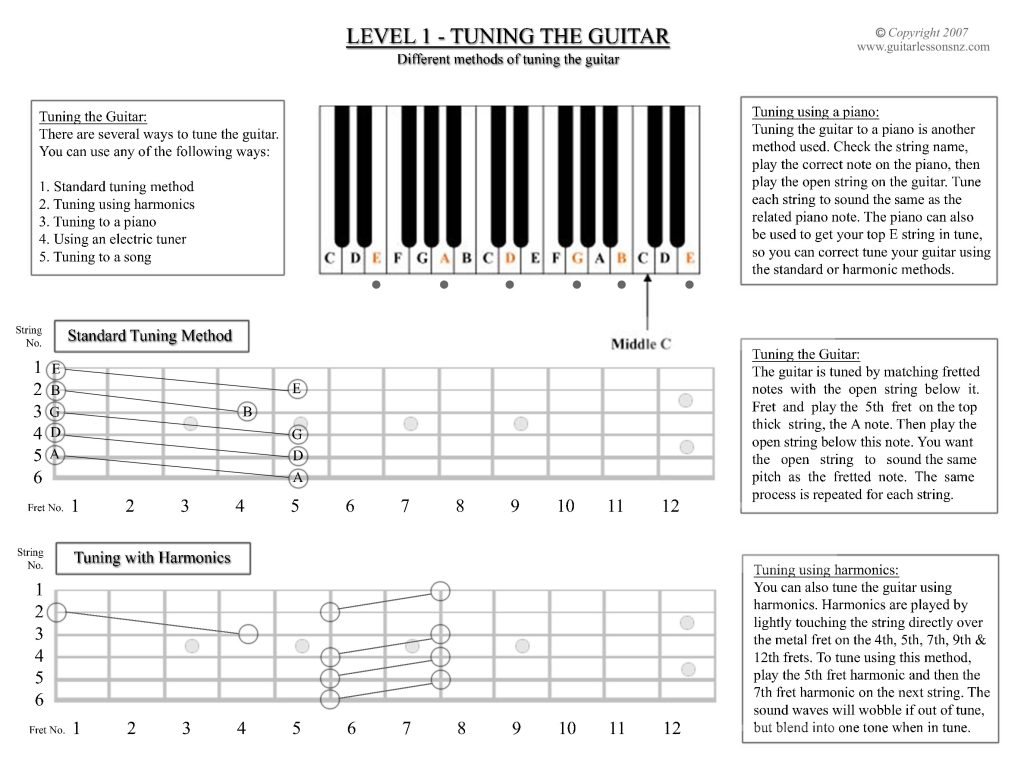
In this method, you are matching the notes exactly to get the proper tuning. The notes are the same in pitch. If you’re off on one of the strings, the rest of them will be out of tune also, so be careful. Another way to tune is by octaves. An octave is the interval between two notes with the same name. If you played the C major scale: C D E F G A B C, the two C’s are one octave apart. You can tune with octaves as follows:
6th string open and 5th string, 7th fret
5th string open and 4th string, 7th fret
4th string open and 3rd string, 7th fret
3rd string open and 2nd string, 8th fret
2nd string open and 1st string, 7th fret
By now you’re probably wondering, “What about the tuning of the 6th string?” Good point. When you tune the rest of the strings from the 6th, it’s called “Relative Tuning.” Although you may not be in tune with a piano, you will be in tune with yourself and that’s fine for practicing. If you want to be in “Concert Pitch,” you will either need to tune from another instrument or from a pitch pipe. I recommend that you get a pitch pipe. It’s good for ear training and it’s easier to carry around than a piano!
Yet another way that I will tune is by simply using chords. Once you know how they are supposed to sound, they become very handy in tuning. I prefer starting with E major, then I play a G major and tweak it a little if necessary. Then D major. All three are the open position chords at the top of the neck. I guarantee you’ll be amazed at how great a perfectly tuned guitar will sound! After all, there is really no other alternative!